


Limited Stock
BioApex - FasciaFlow
BioApex - FasciaFlow
A daily capsule formulated to rehydrate dense, tight fascia in your hands — the connective tissue layer behind the stiffness, aching, and weakening grip that braces can't reach.
Looser Fingers
Restores flexibility to stiff hands
Easier Mornings
Loosens tight, dehydrated fascia
Longer Sessions
More rows before the ache sets in
Steadier Grip
Hold needles & hooks with ease

Made for
Knitters & Crocheters
Hand comfort · 2026
Impossibile caricare la disponibilità di ritiro


Fascia is the connective tissue layer between your skin and your muscles.
It runs through your entire body in one continuous sheet — wrapping every muscle, every joint, every tendon in your hands. When it's hydrated, it's translucent and elastic. When it dehydrates, it densifies and tightens.

Search interest for "fascia release" in the United States, 2022–2026. Source: Google Trends.
The Fascia Layer
Hydrated vs. dehydrated. Your hands feel the difference.

From Knitters And Crocheters Who've Tried Everything.
Reviews from knitters and crocheters who tried FasciaFlow after years of stiff, aching hands, and braces that didn't fix it.


The Science Behind
FasciaFlow
Over time, the fascia in your hands — the thin web wrapping every tendon, joint, and nerve from your wrist to your fingertips — dehydrates, stiffens, and forms adhesions. Instead of gliding freely with every stitch, it binds, compresses, and pulls. Stiffness, aching, and a grip that gives out follow.
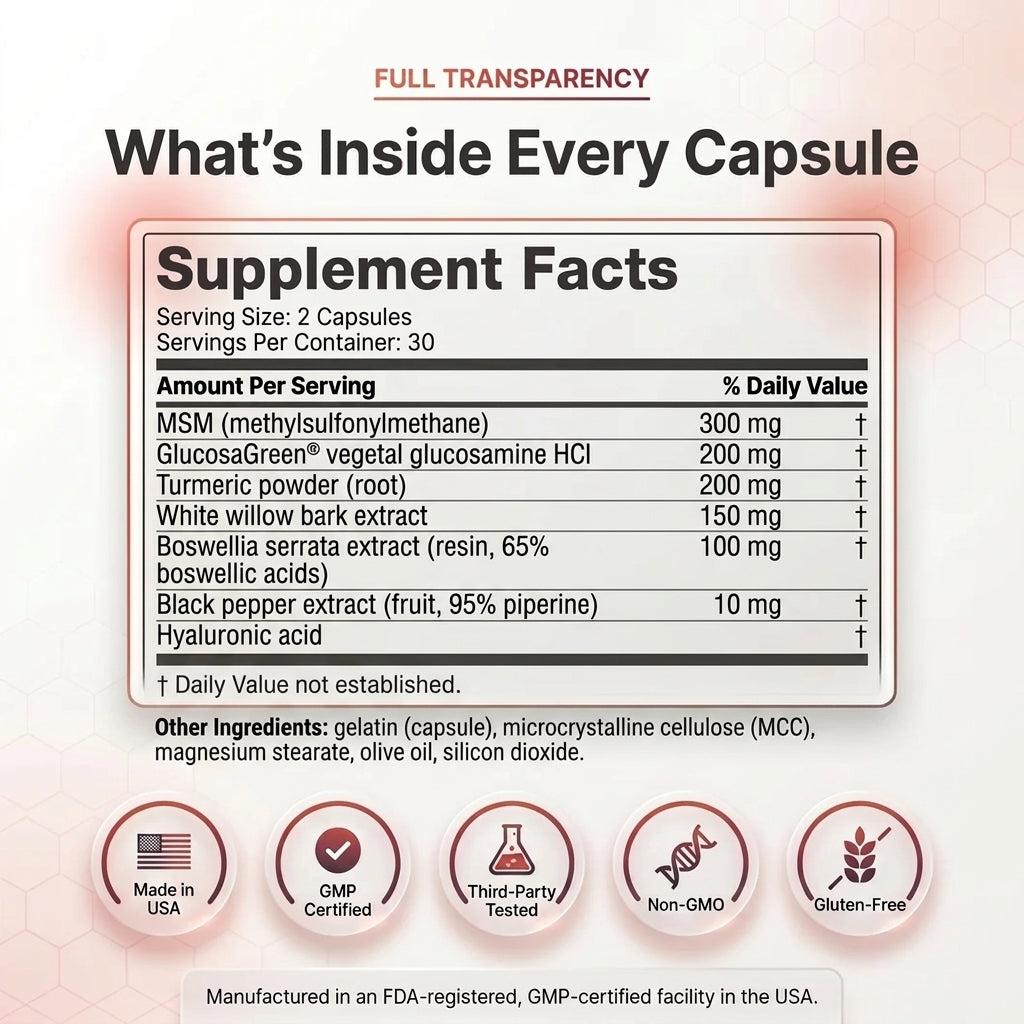
Our FasciaFlow formula delivers what tight, stiff connective tissue needs — MSM, glucosamine, and hyaluronic acid, plus turmeric, boswellia, and white willow bark, built on years of research into connective tissue health.
The formula rehydrates your fascia from within, breaks down the fibrous adhesions locking it in place, and replenishes the fluid that lets each layer glide smoothly again — instead of binding against the tendons and nerves in your hands.
With fascia restored and mobile, your hands start moving the way they used to — fingers bend more freely, your grip holds longer, and the stiffness that built up over years of stitches starts to release. More rows. Longer sessions. Back to the projects you love.
Your Transformation
Timeline
A general timeline of what to expect — individual results may vary based on severity and consistency.
WEEKS 1–2 | Foundation
You're building nutrient levels in your tissue. Most people don't feel dramatic changes yet — and that's normal. Your body is absorbing what it needs to start rehydrating the fascia around the tendons in your hands, from the inside. Keep taking it, keep knitting. The work is already underway.
WEEKS 3–4 | Early Release
This is when most people start noticing. Picking up your needles in the morning takes less coaxing. The stiffness that used to set in after a few rows waits a little longer. These early wins signal that adhesions are releasing and your fascia is beginning to glide again.
MONTHS 2–3 | Active Remodeling
Bigger changes settle in. Fine yarn and small needles feel possible again. Longer sessions, steadier tension, less stopping to shake your hands out between rows. Your knitting group notices you're bringing projects again. Your body is actively rebuilding healthy, hydrated fascia — and the cumulative effect shows in every stitch.
MONTHS 4–6 | Structural Integration
For long-standing stiffness, this is where real change happens. Your fascia has remodeled. What once felt like a fight — the cast-on, the tight stitches, the last row of the night — feels normal again. The changes are structural, and they hold.
Our Impact Statistics
Clinician Recommendations
Trusted by hand therapists and healthcare professionals who understand fascia
Clinical Studies
Ingredients backed by rigorous, peer-reviewed research
Of Knitters Reported Less Hand Stiffness
Within their first 3 months of daily use
Common
Questions
Everything you need to know about fascia, your hands, results timelines, and what to expect
Real knitters, real hands
Why knitters are
trusting FasciaFlow
I own every ergonomic hook they make. Furls, the padded ones, the curved ones, the fat rubber grips. They help my grip, I'll give them that. But they don't do anything about my hand, because the problem was never the hook. After about a month on FasciaFlow the inside of my hand feels looser in a way I can't really explain. I still use the nice hooks, I'm just not depending on them to get through a row anymore.
I wore compression gloves to bed for two years straight. They felt fine at night and by noon I was stiff as a board again, so I'd end up wearing them during the day too, which is not easy when you knit. Somebody in a Facebook group mentioned fascia and the whole "outside vs. inside" idea made sense to me. Most days I haven't needed the gloves since about week 6. I keep them in the drawer just in case.
I had a basket of half-finished Christmas gifts from LAST year sitting in the guest room. Every time I walked past it I felt guilty. Scrolling Instagram and seeing everyone's finished projects made it worse. I'd given up on bulky yarn completely because big needles hurt too much. Two months on FasciaFlow and I've finished three of those gifts. My husband noticed before I did. He said I'd stopped rubbing my hands at night while we watch TV.
Something nobody tells you: when your grip goes, your tension goes with it. My gauge was all over the place because I was either clenching to fight the stiffness or losing my hold on the yarn. I'd started using a tension ring just to stay consistent. About 6 weeks in, I'm not fighting my own hand anymore and my stitches are even again. My swatches finally look like mine. I keep the bottle next to my yarn so I never forget a dose.
Fish oil, collagen, a copper bracelet, a CBD cream my neighbor swore by. I've tried them all, so believe me when I say I was skeptical. What got me to try this was the explanation: a brace or a cream works from the outside, and none of the pills I'd taken were made for the tissue around the tendons in your hand. Six weeks in, I'm knitting socks on size 1 needles again. I had given up on socks completely two years ago.
I switched from English to continental, then to Portuguese style, trying to find something that didn't hurt. Every switch bought me a few months before the ache caught up. I'm 74 and I'm stubborn, so quitting was never really an option, but I was knitting less and less. I've been taking FasciaFlow since the summer. I'm not going to pretend I'm 40 again, but I can do a solid hour now without my hand cramping up, which I couldn't do in spring.
Baby blankets are my thing. I've made one for every baby in our church for 20 years. Last year I had to tell two families I couldn't, and it about broke my heart. My hands would ache so badly after a session I couldn't hold a dish to wash it. My daughter found FasciaFlow and ordered it for me. It was slow, nothing for the first few weeks, but by the second month I was back at it. Three blankets done since August.
My rheumatologist told me to "just knit less." That's like telling someone to breathe less. Knitting is how I relax, how I see my friends, how I make gifts for people I love. I took that advice for about six months and I was miserable. FasciaFlow didn't make the arthritis go away and I didn't expect it to. What it did was take the edge off the tightness so I could go back to doing the thing that keeps me sane.
I'm a slow believer. I read everything about fascia before buying because I'd been burned by supplements before. The research on how fascia stiffens when it dries out made sense with what I feel: it's not just the knuckles, it's this tight, pulling feeling through the whole hand. Week 3 I noticed mornings were easier. Week 8 I'm crocheting most evenings again. The 90-day guarantee is what finally got me to click buy, and I won't need it.
For two years my yarn stash just sat there taunting me. I'd watch YouTube tutorials and plan projects in my head, then my fingers would lock up after a few rows. I really thought this was just getting old and I had to accept it. I'm 68 and I'm about 10 weeks into FasciaFlow. I just finished a lace shawl, the first fine project I've done since 2023. I cried a little when I blocked it, not going to lie.
Preview reviews and rating, replace before launch.
- Scegliendo una selezione si ottiene un aggiornamento completo della pagina.
- Si apre in una nuova finestra.